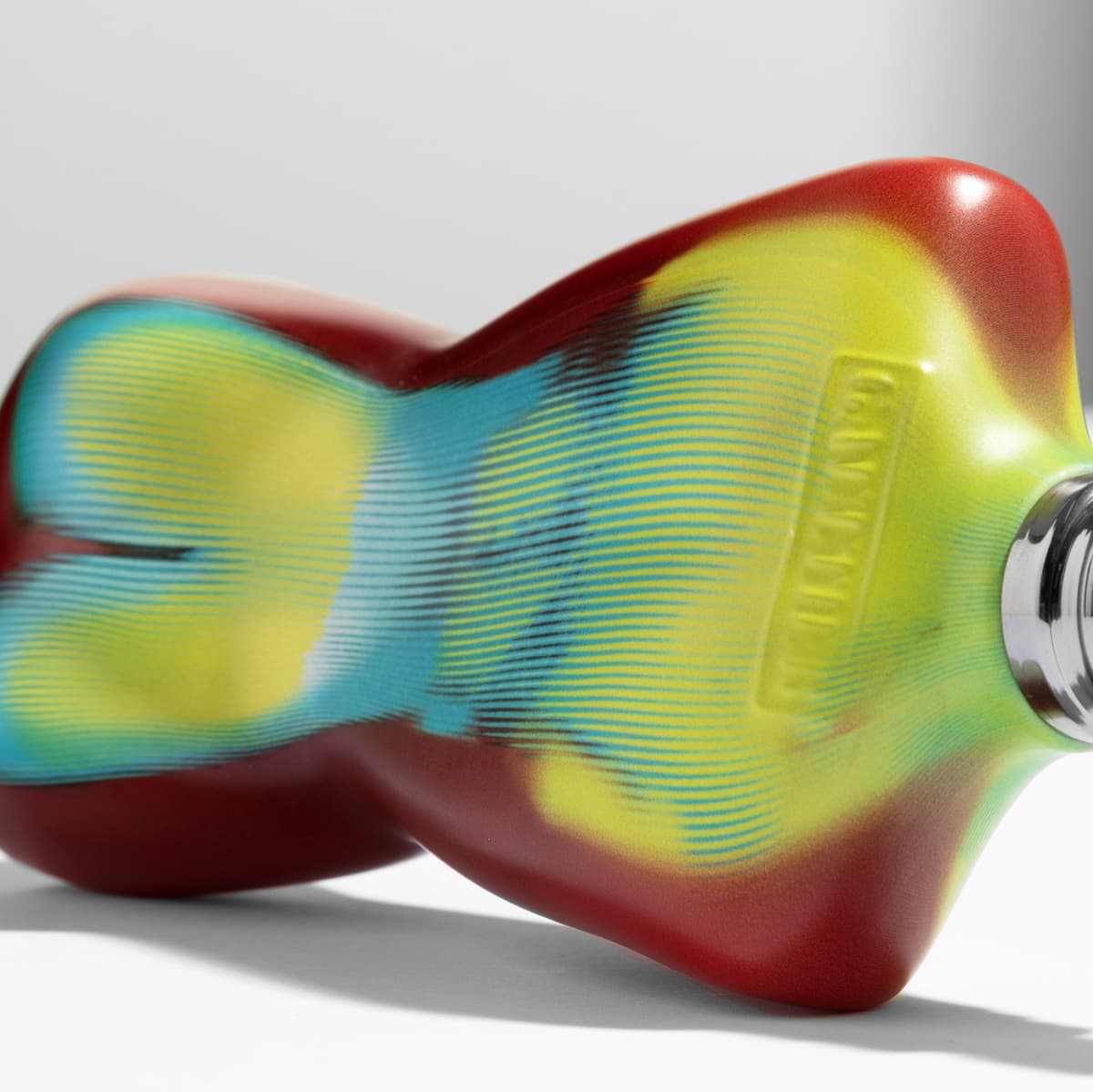
HD digital sublimation for perfume flacons, caps and candle jars. Full 360° decoration, base to neck, up to 1200 dpi — on the tapered, curved and faceted geometries that define luxury perfumery, caps included. From 5,000-piece limited editions to several million units per project, produced in Verona, Italy.
Trusted by houses within the LVMH and Pernod Ricard groups.
Tapered shoulders, curved faces, concave details, sculpted bases — the shapes that define a luxury flacon are exactly what standard decoration refuses. Digital sublimation covers the full surface, base to neck, in one 360° operation — no seam, no colour break, no undecorated side. The artwork is designed for the whole object, not for one flat panel.
A flacon lives in prolonged, aggressive contact with what it holds: high-alcohol juice, essential oils, daily handling for years. For perfumery projects we specify a protective top coating for chemical resistance as standard, and the artwork is cured into the coating at temperatures never above 180°C — part of the surface, not a layer resting on it. Validated on the physical sample you approve.
A fragrance is judged as one object, and the cap gives away more than most briefs admit. The same process decorates glass, zamac and aluminium — so flacon and cap carry one continuous artwork, matched and produced under the same colour management, instead of two technologies that almost match. The approach behind Bvlgari Le Gemme Tygar, below.
Up to 1200 dpi with no limits of colour or shades — photographic gradients, generative art, textile-grade pattern — transferred to the surface exactly as the file describes it. And pricing is independent of design complexity: what drives price is decoration typology and top coat, vessel size and quantity. Millions of shades are quoted like a one-colour crest.
Digital sublimation at ATIU — Verona, Italy
Whatever you can design, we can make real.
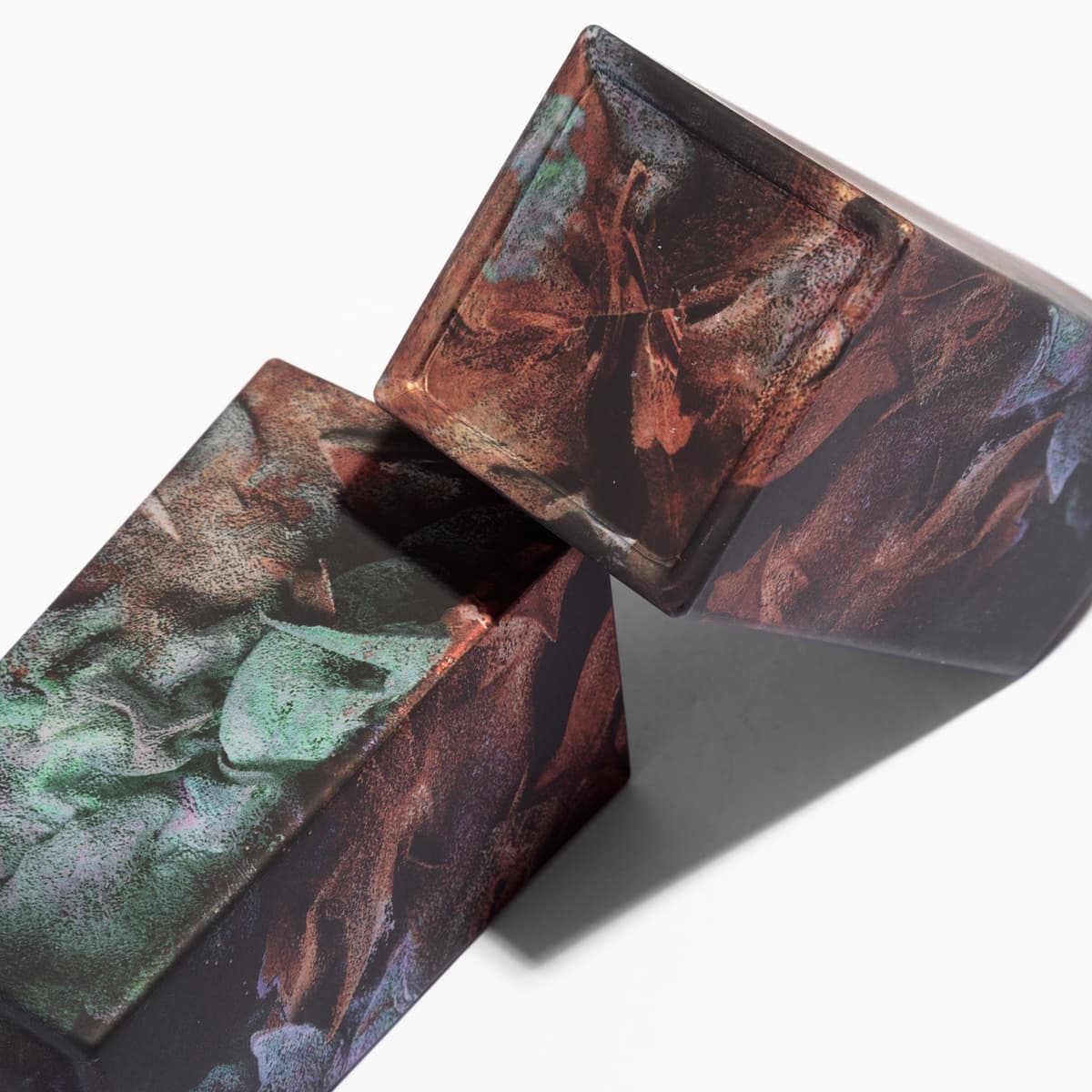
When the perfume formula becomes the artwork.
For Le Gemme Tygar, Bvlgari worked with digital artist Refik Anadol: the perfume formula became a dataset, and Anadol’s AI system turned that data into the visual language of the packaging — a living artwork with no limits of colour or shades, meant to be reproduced without simplification.
ATIU translated it to the components with digital sublimation over a premium metallic soft-touch primer — tactile softness, metallic iridescence and a full-colour wrap in one build. The artwork runs continuous across the glass flacon and the zamac cap, ennobled and matched to the glass so the two materials read as one continuum — recognised with a Formes de Luxe Award 2025.
Decoration: ATIU
Read the full project →Before the artwork, the surface. The primer sets the character of the flacon — how it catches light, how it feels in the hand, whether the glass and the juice stay visible. Eight finishes, each available as full-body, partial, sheer or gradient coverage, each carrying the same HD artwork on top. A creative decision, not a technical afterthought.
Your first physical sample is produced in five working days — on the production line itself. Colour is matched from your Pantone or Cromalin references in calibrated CMYK; the piece you approve becomes the production reference, held to agreed dE or light/dark limit standards throughout the run. What you approve is what ships.
Flankers and limited editions from 5,000 units; permanent SKUs up to several million units per project, at 4,000 pieces per hour and up to 30 million pieces per year per plant. Volume thresholds run up to one million units on the price list — start small, scale on the same approved standard.
Every project starts under NDA, before a single file is exchanged — big-house confidentiality requirements are our normal operating mode. Unreleased names, collaborations and launch dates stay inside the team that needs them. Your artwork and design remain your intellectual property, without exception.
EXW or DAP, shipping worldwide — Europe, the Americas, UAE. Production lead time around one month from PO, retro-planned with you against your filling schedule and launch date. On request, a trial pallet of decorated components to validate behaviour on your filling lines before full production.
ISO 9001 · EcoVadis Committed · Zero net CO₂ since 2023 · Verona, Italy
Digital sublimation uses a waterborne coating and waterborne inks, adds no plastic to the component, and cures at temperatures never above 180°C. The decoration is a minimal surface layer — the glass stays fully recyclable.
Behind the process, the company: zero-net carbon since 2023 — Scope 1, 2 and 3, certified with Up2You — EcoVadis Committed and ISO 9001 certified. Decoration increasingly lands on the CSR desk as well as the creative one; this clears both.
Request a mock-up
Send your flacon reference and your artwork — we send back sublimation renderings on your own bottle. Then a production-line sample in five working days. No setup costs. No commitment.
Yes. The same sublimation process decorates glass, zamac and aluminium, under the same colour management, so flacon and cap can carry one continuous artwork with no break where the materials change. On Bvlgari Le Gemme Tygar × Refik Anadol, the zamac cap was ennobled and matched to the glass so the two components read as one continuum.
For perfumery projects ATIU specifies a protective top coating for chemical resistance as standard. Perfume means prolonged contact with alcohol and essential oils, plus daily handling — the top coat is engineered for exactly that exposure, the artwork is cured into the coating so it is part of the surface, and everything is validated on the production-line sample you approve.
From 5,000 units, up to several million units per project — with volume thresholds up to one million units on the price list. Pricing is independent of design complexity: it is driven by decoration typology and top coat, vessel size and quantity, so an ambitious artwork costs the same as a simple one.
Five working days for a production-line sample — produced on the same line as the full run, so the sample is the production standard, not an approximation of it. Production lead time is around one month from PO, retro-planned against your launch date.
Colour is matched from your Pantone or Cromalin references in calibrated CMYK. You approve the physical sample, which then becomes the production reference — held to an agreed dE tolerance or light/dark limit standards throughout the run.
Every project starts under NDA, before a single file is exchanged — standard practice, and large-group confidentiality requirements are welcome. Unreleased names, artist collaborations and launch dates stay inside the team that needs them. Your artwork and design remain your intellectual property at every stage, without exception.